
Indian Paintings -History
Indian painting has a very long tradition and history in Indian art, though because of the climatic conditions very few early examples survive. The earliest Indian paintings were the rock paintings of prehistoric times, such as the petroglyphs found in places like Bhimbetka rock shelters. Some of the Stone Age rock paintings found among the Bhimbetka rock shelters are approximately 10,000 years old.
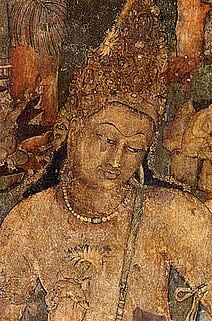
Indian paintings can be broadly classified as murals, miniatures, and paintings on cloth. Murals are large works executed on the walls of solid structures, as in the Ajanta Caves and the Kailashnath temple. Miniature paintings are executed on a very small scale for books or albums on perishable material such as paper and cloth. Traces of murals, in fresco-like techniques, survive in a number of sites with Indian rock-cut architecture, going back at least 2,000 years, but the 1st and 5th-century remains at the Ajanta Caves are much the most significant.
Paintings on the cloth were often produced in a more popular context, often as folk art, used for example by traveling reciters of epic poetry, such as the Bhopas of Rajasthan and Chitrakathi elsewhere, and bought as souvenirs of pilgrimages. Very few survivors are older than about 200 years, but it is clear the traditions are much older. Some regional traditions are still producing works.
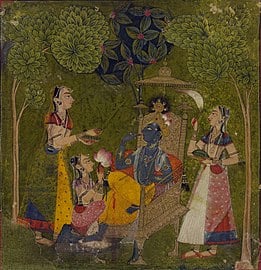
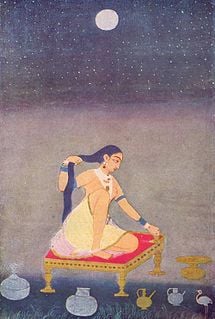
The great period of Mughal court painting begins with the return of Humayun from exile in Persia in 1555, bringing Persian artists with him. It ends during the reign of Aurangzeb who rather disapproved of painting for religious reasons, and disbanded the large imperial workshop, by perhaps 1670. The artists dispersed to smaller princely courts, both Muslim and Hindu, and the “post-Mughal” style developed in many local variants. These included different Rajasthani schools of painting like the Bundi, Kishangarh, Jaipur, Marwar, and Mewar. The Ragamala paintings also belong to this school, as does the later Company painting produced for British clients from the mid-18th century.
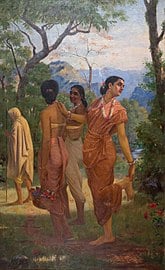
Modern Indian art has seen the rise of the Bengal School of art in the 1930s followed by many forms of experimentation in European and Indian styles. In the aftermath of India’s independence, many new genres of art were developed by important artists like Jamini Roy, M. F. Husain, Francis Newton Souza, and Vasudeo S. Gaitonde. With the progress of the economy, the forms and styles of art also underwent many changes. In the 1990s, the Indian economy was liberalised and integrated into the world economy leading to the free flow of cultural information within and out.
 GraffitiArena